musical Arts(artes musicales)
A)objetive
Music, like all artistic manifestations, is a cultural product. The purpose of this art is to provoke an aesthetic experience in the listener, and to express feelings, circumstances, thoughts or ideas. Music is a stimulus that affects the perceptual field of the individual; thus, the sound flow can fulfill various functions (entertainment, communication, setting, etc.).
b)Activity and introduction
The learning
and teaching of music are essentially based on musical pleasure and interest,
which must be developed in practice in response to a triple ambition:
a) develop
the auditory and aesthetic sensitivity of the students, making available
various repertoires and forms of musical performance, both daily and those
unusual;
b) stimulate
and refine their ability to express themselves in art and invention by familiarizing
themselves with different technical tools of interpretation and musical
composition;
c)
understand, identify and appreciate characteristics, repertoires and aesthetic
trends in the music of one's own culture and of others, based on musical practices
and auditions.
The
artistic-musical discipline is particularly demanding in terms of techniques:
in vocal and instrumental interpretation, in the listening of works, and in the
precise identification of elements that make up musical language, for which the
ear, the body, the voice, intelligence and gaze must slowly become familiar
with the wide world of music.


c)development
*Written material:
musical arts: the art of organizing a coherent and sensible
combination of sounds and silences using the fundamental principles of melody,
harmony and rhythm, through the intervention of complex psycho-emotional
processes. The concept of music has evolved since its origin in ancient Greece,
where poetry, music and dance were brought together without distinction. For
several decades, the definition of what music is and what it is not has become
more complex, since prominent composers, in the framework of various border
artistic experiences, have produced works that, although they could be
considered musical, expand the limits of the definition of this art.
Definition of music

*video of class
The notes are written on the staff (from the Greek, penta:
five, gram: letter, writing):

On the staff we write the key that determines the note that
corresponds to each line and space. In the following example we see the treble
clef. This key is used for treble instruments such as the flute and the violin
and indicates that the notes written on the second line correspond to the G
note:
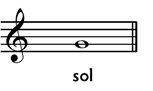
The space above the line of the note sol corresponds to the
note la, the line following the note if. The notes on the staff follow the
order of the notes (do, re, mi, fa, sol, la and si) in ascending and descending
order alternating between lines and spaces starting from the sol note:
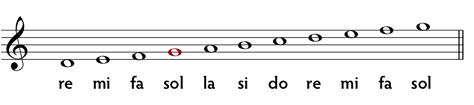
Using additional lines we can write notes that are higher in
the sun and lower than the re:

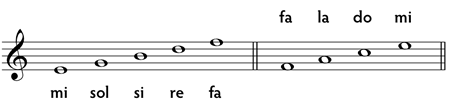
To facilitate the memorization of the notes on the staff, it
is recommended to learn the order of the notes on the lines and spaces:
d)theme evaluation
Comentarios
Publicar un comentario